Wisconsin's expungement law is different from most states, and that difference trips up a lot of people. In most places, you can petition for expungement years after you finished your sentence. In Wisconsin, you generally had to ask for expungement at the moment of sentencing — and if your attorney didn't bring it up, or the judge didn't grant it, you may have lost your only chance under the main law.
That's a hard thing to read. If you're coming to this page hoping to clear a conviction from years ago and nobody told you to request expungement in court, this guide will be honest with you about what your options are — and what they aren't.
There is a narrow exception for some misdemeanor convictions, and there are alternatives like a Governor's pardon that are worth knowing about. This guide covers all of it.
This guide explains how the law works in general terms. Whether you qualify depends on your specific record, and a judge makes the final call. If your situation is complicated — multiple convictions, charges in multiple states, or a previous denial — consulting a lawyer who handles expungement is worth the cost of a consultation.
The Two Pathways in Wisconsin
Wisconsin law (Wis. Stat. § 973.015) creates two separate situations where expungement is possible. Most people only have access to one of them — and which one you have depends on decisions made at your sentencing, not decisions you're making now.
Pathway 1: At-sentencing order (the main path)
This is how most Wisconsin expungements work. At the time of sentencing, the judge can order that the record will be expunged after you successfully complete your sentence. For this to happen:
- You (or your attorney) had to request expungement before or at sentencing
- You had to be under 25 years old at the time of the offense
- The offense had to be a misdemeanor, a Class H felony, or a Class I felony
- The judge had to agree it was in the public interest
If the judge granted it, the expungement order is part of your judgment of conviction document. You don't receive the actual expungement at sentencing — you receive apromise of expungement. After you complete your sentence, you file a petition and the court carries it out.
Pathway 2: Post-conviction petition (narrow exception)
In 2016, Wisconsin added a second path for a specific group of people. Under this path, you can petition for expungement after conviction without having had it ordered at sentencing — but only if all of these are true:
- You were convicted of a misdemeanor tried in circuit court (not a felony)
- You were under 25 at the time of the offense
- Expungement was not previously ordered at sentencing
- You have completed your sentence
This path does not apply to felonies. If you were convicted of a felony and expungement was not ordered at sentencing, Wisconsin's expungement statute generally does not offer you a remedy. That is a real limitation of Wisconsin law.
- For felony convictions: if expungement was not ordered at sentencing, you cannot generally get it now under Wis. Stat. § 973.015. This is not a technicality — it is how the law is written.
- For misdemeanor convictions: the 2016 post-conviction petition path may still be available if you were under 25 at the time of the offense.
- A Governor's pardon is a separate process that can restore rights and may be worth pursuing for older convictions. See the section below.
- Some people who were convicted decades ago — when the law was interpreted differently — have successfully petitioned for expungement. Consulting an attorney is worth it if you are unsure.
- Arrests that did not result in a conviction can often be expunged regardless of when they occurred — see your county clerk for details.
Wisconsin's Department of Justice processes expungements after the court issues a certificate. The record is destroyed at the state level, which is stronger than sealing.
Who Can and Can't Get Expungement
Here is a plain-language breakdown of who qualifies and who doesn't. The most important factor — aside from the sentencing question — is your age at the time the offense occurred.
- People convicted of any misdemeanor who were under 25 at the time the offense was committed
- People convicted of a Class H felony who were under 25 at the time the offense was committed
- People convicted of a Class I felony who were under 25 at the time the offense was committed
- People who successfully completed their full sentence (probation, fines, community service)
- People who requested expungement at sentencing and had it ordered by the judge
- People convicted of a misdemeanor in circuit court who were under 25, even if not ordered at sentencing (limited post-conviction path)
- People who were 25 or older at the time they committed the offense
- Class A through Class G felony convictions (even if under 25)
- Violent offenses
- Sex offenses that require registration on the sex offender registry
- Crimes against children
- Convictions where probation was violated and the judge denied expungement
- People who did not request expungement at sentencing and were convicted of a felony
- Traffic violations (handled through a separate process)
Age is calculated at the date of the offense, not the date of conviction or sentencing. If you were 24 when the crime happened and 26 when you were sentenced, you may still qualify.
The Age Rule: Under 25 at the Time of the Offense
This is one of the details that catches people off guard. Wisconsin law requires that you were under 25 years old at the time you committed the offense — not at the time of your arrest, not at the time of your conviction, and not at the time of sentencing. The relevant date is when the crime happened.
This matters because criminal cases can take months or even years to resolve. Someone who was 24 when an offense occurred might be 26 or 27 by the time they're sentenced. Under Wisconsin law, that person still meets the age requirement because they were under 25 when the offense took place.
Conversely, if you were 25 or older when the crime occurred, Wisconsin's expungement law does not apply to you — regardless of how old you are now or how long ago the conviction happened.

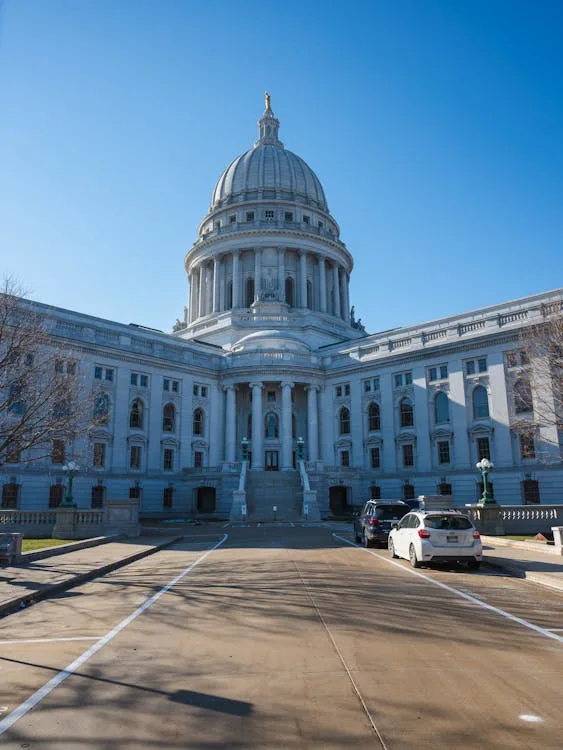
The Wisconsin State Capitol in Madison. Circuit court expungement petitions are filed at the county courthouse where you were convicted, not at the Capitol.
Photo: Sigrid Neidhardt / Pexels
How the Process Works, Step by Step
If you have confirmed that expungement was ordered at sentencing (or your record may be eligible for the post-conviction misdemeanor petition), here is what the actual process looks like.
The Wisconsin Expungement Process
Step 1: Check whether expungement was ordered at sentencing
A few days • FreePull your court records from the Wisconsin Circuit Court online case records system at wicourts.gov. Look for a "judgment of conviction" document. If expungement was ordered, it will be noted there. If you are not sure, call the clerk of courts in the county where you were sentenced. Tip: If expungement was not ordered at sentencing and your offense was a felony, your options under Wisconsin law are very limited. Skip ahead to the "What if you don't qualify?" section.
Step 2: Complete your sentence
Depends on your sentence • No filing cost at this stageYou must fully complete your sentence before you can ask the court to carry out the expungement. That means finishing probation, paying any fines, completing community service, and meeting every condition the judge set. If you violated probation, the court may deny the expungement even if it was ordered at sentencing. Tip: Keep copies of everything that shows you completed your sentence — discharge papers, payment receipts, letters from your probation officer. You will need these.
Step 3: File a petition for expungement with the circuit court
4–8 weeks for the court to process • $150–$300 filing fee (varies by county)File in the circuit court in the county where you were convicted. Ask the clerk for the petition form — it is sometimes called a "Petition for Certificate of Expungement." Include documentation showing you completed your sentence. The court will review whether you met all the conditions originally set at sentencing. Tip: Ask about fee waivers when you pick up the form. Wisconsin courts use a financial hardship process — see the fees section below.
Step 4: Court issues a certificate of expungement
4–12 weeks after approval • No additional costIf approved, the court issues a certificate of expungement and notifies the Wisconsin Department of Justice (DOJ). The DOJ updates the state crime information bureau record. This is true expungement — not sealing. The record is destroyed at the state level. Tip: After you receive the certificate, request a copy of your updated Wisconsin DOJ record to confirm the change went through.
Step 5: Notify private background check companies
1–6 months per company • Usually free to requestWisconsin state records are updated, but many private background check companies operate their own databases. They are not automatically notified when your record is expunged. You may need to contact major reporting companies like LexisNexis, Equifax Workforce Solutions, and others directly to request they update your file. Tip: Keep your certificate of expungement. You will need it when disputing records with private companies.
When Can You File?
Wisconsin does not have a traditional waiting period the way many states do. There is no "wait three years after your conviction." Instead, the timing requirement is simpler: you must complete your sentence before you can petition for expungement.
"Completing your sentence" means everything — probation, jail time, fines, community service, and any other conditions the court set. Once all of that is done, you can file your petition. The court then decides whether to issue the certificate of expungement based on whether you met the conditions.
The clock starts on the date shown below — not your arrest date.
Misdemeanor — probation or sentence served
Clock starts: Date you complete probation, jail, or other sentence
The expungement order must have been granted at sentencing. Once sentence is done, petition the court to carry out the expungement.
Class H or I felony — probation completed
Clock starts: Date you complete probation or supervised release
Same rule: court must have ordered expungement at sentencing. Felony violations of probation can result in expungement being denied.
Post-conviction petition (misdemeanor only)
Clock starts: Date you complete your sentence
Available only if you were under 25 at the time of the offense and the case was tried in circuit court. Cannot use this path for felonies.
What Wisconsin Expungement Actually Does
Wisconsin's expungement is stronger than what most states offer. A lot of states use the word "expungement" but actually seal records — meaning the record still exists, it's just hidden from most searches. Wisconsin is different.
When Wisconsin expunges a record, the record is destroyed. The circuit court strikes the conviction from the record. The Wisconsin Department of Justice updates the Crime Information Bureau entry. After expungement:
- You can legally say you have not been convicted of that offense on most job applications, housing applications, and licensing forms
- Wisconsin state background checks will not show the conviction
- The record is gone at the state level — not just sealed or restricted
There are important limits. Wisconsin expungement does not affect federal records. If your conviction involved a federal crime or was prosecuted federally, this process does not help. It also does not affect records held by private background check companies — you have to dispute those separately.
Certain employers — law enforcement agencies, employers licensed by the Department of Financial Institutions, and some professional licensing boards — may still be able to inquire about expunged convictions. If you are applying for jobs in these areas, consult an attorney before assuming the conviction is fully invisible.
What If You Don't Qualify?
If you were 25 or older when the offense occurred, or if you were convicted of a Class A through G felony, or if you were convicted of a felony and expungement was not ordered at sentencing — Wisconsin's expungement statute is not available to you. That is the honest answer, and you deserve to know it clearly.
That doesn't mean you're out of options. Here are alternatives worth knowing about:
Governor's Pardon
Wisconsin has a Governor's Pardon Advisory Board. A pardon does not erase your record the way expungement does, but it is an official act of forgiveness from the state that can restore civil rights (like voting and serving on a jury), and it carries significant weight in employment and licensing contexts.
To apply, you submit a pardon application to the Pardon Advisory Board, which reviews it and makes a recommendation to the Governor. The Governor makes the final decision. There is no guarantee of approval, and the process can take a year or more. But for people with older convictions who have demonstrated rehabilitation, a pardon is a meaningful and real option.
You can find information and applications at the Wisconsin Pardon Advisory Board's website. Legal aid organizations can help you prepare a strong application.
Federal Expungement (Limited)
Federal law does not have a general adult expungement statute. For federal convictions, options are extremely limited. A federal pardon is possible but rare. If your conviction was federal, consult an attorney who specifically handles federal post-conviction matters.
Background Check Disputes
If your case was dismissed, you were acquitted, or you completed a diversion program, you may have grounds to dispute background check records even without formal expungement. The Wisconsin DOJ and the major credit reporting and background check companies have dispute processes. A legal aid attorney can help you identify which records can be corrected.
What Documents You'll Need
- Your court records showing the original judgment of conviction
- Documentation that expungement was ordered at sentencing (look for language in the judgment)
- Proof of sentence completion: discharge papers from probation, payment receipts for fines, community service completion letters
- Completed petition form from the clerk of courts
- Valid government-issued ID
- Your current address — the court will mail you the certificate
- Any documentation of rehabilitation, employment, or community involvement (helpful but not always required)
Some counties have specific local forms. Always confirm with the clerk of courts in your county before filing.
Fees and Fee Waivers
Filing fees for expungement petitions in Wisconsin vary by county. Most counties charge somewhere between $150 and $300. That is not a small amount, and it is a real barrier for people who are already dealing with the financial weight of a conviction.
Fee waivers are available. Wisconsin courts have an indigency waiver process. If you cannot afford the filing fee, ask the clerk of courts for a fee waiver form — sometimes called a "Petition to Proceed Without Payment of Fees." You will need to show your income, expenses, and assets. Many people who are working low-wage jobs or are unemployed qualify.
Do not let the filing fee stop you from pursuing expungement if your record may be eligible. Ask about the waiver. The worst they can say is no, and most clerks are used to this request.
There are no additional fees for the DOJ record update once the court issues the certificate of expungement. That part is handled automatically.
Not legal advice. This guide explains how the law generally works. Your situation may be different. A lawyer who specializes in expungement can tell you how the law applies to your specific case.
Marijuana Convictions
Wisconsin passed limited measures in recent years related to marijuana conviction records, but Wisconsin has not fully legalized marijuana, and there is no broad automatic marijuana expungement program in place as of 2026. If you have a low-level marijuana possession conviction, your eligibility for expungement follows the same rules as any other misdemeanor — age under 25 at time of offense, and the sentencing order requirement.
If marijuana legalization progresses in Wisconsin in the future, expungement provisions may expand. Check back, or consult a local legal aid organization for the current state of the law.
Free Legal Help in Wisconsin
You do not have to go through this alone. Several organizations in Wisconsin provide free or low-cost legal help for expungement cases. These organizations will not charge you for a consultation, and many will represent you through the whole process at no cost if you qualify based on income.
- Wisconsin State Public Defender — pd.wi.gov — free representation for qualifying people
- Legal Action of Wisconsin — legalaction.org — free civil legal help, including expungement assistance
- Wisconsin Legal Aid Society — covers several counties including Milwaukee and Dane
- Wisconsin Law Help — wisconsinlawhelp.org — free guides and referrals
- Local law school clinics — UW Law and Marquette Law both have student clinics that handle expungement cases at no cost
- Wisconsin Courts Self-Help Center — wicourts.gov — court forms and instructions
Income limits apply to free legal services. Call to ask — most organizations will tell you right away if you may be eligible.
Where to Go From Here
Wisconsin's expungement law is genuinely more restrictive than most states. If you didn't know to ask at sentencing — and a lot of people didn't, especially before attorneys started routinely advising clients about this — you may be facing a wall. That is not your fault. It is a design flaw in how the law was written.
But knowing where you stand is the first step. If your record may be eligible, the process is navigable — and the end result, a truly destroyed record rather than a sealed one, is one of the strongest outcomes any state offers. If you're not eligible under § 973.015, the pardon pathway is real and worth pursuing if you've been living your life right since the conviction.
Either way, reach out to a legal aid organization before you conclude nothing can be done. Wisconsin legal aid attorneys know this law deeply and may see options that aren't obvious from reading the statute alone.
Ready to file? We handle the paperwork.
Pre-filled court forms, step-by-step checklist, and process guidance — so you know exactly what to do next.